
Closing the attainment gap - how we did it (and how we measured it!)
Tassomai
Published
Updated
4 min read
Updated 6th November 2026: we’ve added a short summary of what the evidence says about closing the science attainment gap for disadvantaged pupils, and the results of our more recent Pupil Premium trial.
How can schools close the attainment gap for disadvantaged pupils in science?
The Education Endowment Foundation (EEF) says the science attainment gap is “just as pervasive” as the gap in English and maths: disadvantaged pupils start to fall behind in science in Key Stage 1, and the gap keeps widening through primary and secondary school. Its Improving Secondary Science guidance report (2018) makes seven recommendations that are relevant to all pupils, but particularly to those struggling with science:
Preconceptions: build on the ideas that pupils bring to lessons.
Self-regulation: help pupils direct their own learning.
Modelling: use models to support understanding.
Memory: support pupils to retain and retrieve knowledge.
Practical work: use practical work purposefully and as part of a learning sequence.
Language of science: develop scientific vocabulary and support pupils to read and write about science.
Feedback: use structured feedback to move on pupils’ thinking.
For schools funding this through the Pupil Premium, the Department for Education’s guidance for school leaders groups approved spending into three tiers: high-quality teaching, targeted academic support and wider strategies. Its high-quality teaching tier includes “technology to support high-quality teaching – for example, software to support diagnostic assessment”.
Tassomai supports the memory and feedback recommendations: daily retrieval quizzes bring topics back before they’re forgotten, and teachers see live data on which topics each pupil hasn’t secured yet.
Our Pupil Premium Boost trial
In the 2023/24 school year we ran a Pupil Premium Boost trial across 20 schools and 12,385 students, 3,832 of them Pupil Premium, compared with a control group of around 12,000 students. Pupil Premium students with Boost made about 45% more course progress for every 100 questions they answered than Pupil Premium students in comparable schools without it. You can read the full results in Closing the Pupil Premium attainment gap: results of the Pupil Premium Boost trial.
How we did it in 2018-19
Our earlier study, below, grouped students by their starting scores on Tassomai rather than by Pupil Premium status: it compared students who started with lower scores with those who started with higher scores.

Assessing the impact of any strategy or intervention is a notoriously difficult task, particularly when one considers the external factors at play in any given setting that can dramatically affect the results. When decisions around purchasing or adequately resourcing implementation strategy come into play, the requirement to show evidence becomes increasingly vital to school leaders.
It’s no less of a vexed question for providers: finding evidence of impact is crucial to decision-making processes around the development of products and content, and to be able to assure customers that their investment will prove to be time and money well-spent.
We’ve conducted many trials and experiments over the years to measure impact - and pride ourselves in being a leader in research-led, evidenced EdTech. Having completed an impact study with the IoE into the effect of our videos on knowledge retrieval and retention, Tassomai was awarded an EdWard from UCL. Our correlative analysis on 60,000+ exam results against usage in the product has been well-publicised, showing that over 90% of high users achieved a strong pass in their GCSE.
The challenge, however, was to investigate the effect of our adaptive, personalised spaced retrieval practice on students’ academic progress - we wanted to demonstrate that, whatever the prior attainment, using Tassomai would increase outcomes.
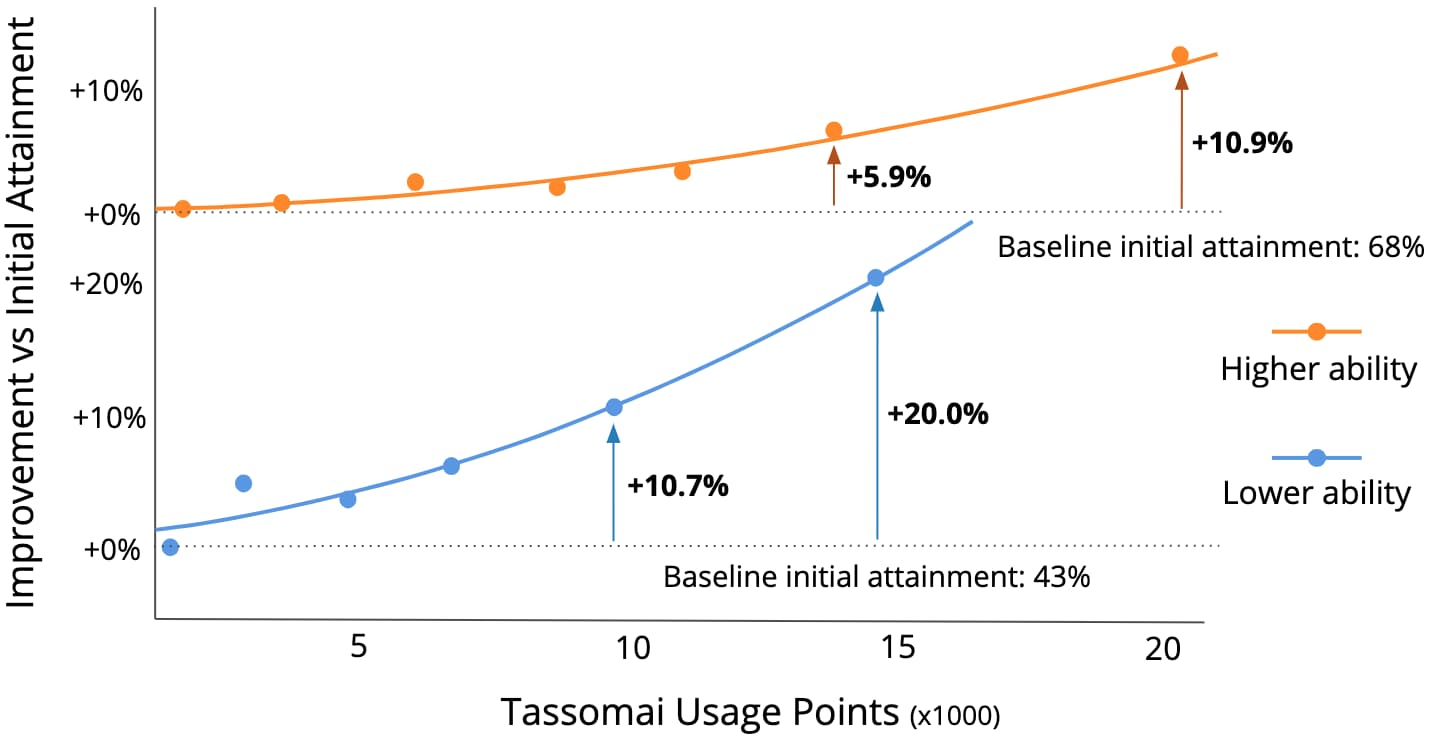
You can find out more detail about the research in this blog post, but in short the experiment was a pre & post test of student subject knowledge on what we term ‘mastery questions’. We looked at the data of around 1500 students around the UK who used Tassomai between September 2018 and May 2019, separated the lower and higher ability based on how they fared on quizzes in their first month of use, and then looked at how their scores in mastery questions improved over time.
Our results showed that, in both groups, students improved in test scores and that this improvement increased with increased usage. Superimposing the graphs for each user type against their respective baselines of attainment, however, showed that the effect of the program was to close the attainment gap between them.
We continue to conduct research on mass cohort data and in collaboration with schools and universities. If you would like your school to participate in a study, please get in touch as we’d love to work with you.
For a fresh look at this 2018-19 study and our 2017 results, including what the data can and can’t tell us, read Beyond correlation: what our 2017 and 2018-19 impact studies show.
Tassomai is an adaptive learning software that supports students in science, maths and English at KS3 and KS4. Using principles of behavioural and cognitive science, the program provides intelligent, personalised daily retrieval exercises for students that teach, test and reinforce knowledge. Teachers and SLT access data on student engagement and understanding through a live-marked interactive PLC to plan schemes of work and intervention.
Tagged: Attainment, grades, Tassomai in schools