
Closing the Pupil Premium attainment gap: results of the Pupil Premium Boost trial
Tassomai
Published
Updated
4 min read
In the 2023/24 school year, 20 schools trialled Pupil Premium Boost, a differentiated intervention in Tassomai for their Pupil Premium students. Pupil Premium students with Boost made about 45% more course progress for every 100 questions they answered than Pupil Premium students in comparable schools without it.
The uplift showed up in every year group from year 7 to year 10. For school leaders, it points to a practical lever: make the time disadvantaged students already spend on independent study count for more. This post sets out how the trial worked, what it found and what it means for your Pupil Premium strategy.
The gap the trial set out to close
Disadvantaged pupils still leave school behind their peers. Department for Education figures for 2025/26 show lower attainment for disadvantaged pupils on every headline key stage 4 measure, with an average Attainment 8 gap of 15.1 points [1]. The Education Endowment Foundation puts the gap at 19 months by the end of secondary school [2].
In our own data, the gap shows up first as time. Pupil Premium students in the trial schools spent about 25% less time on Tassomai than other students. Many of the reasons for that sit outside school. So the trial asked a focused question: could we make the time these students do spend count for more?
How the trial worked
The trial ran across 20 schools and 12,385 students, 3,832 of them Pupil Premium, compared with a control group of around 12,000 students. The control group came from comparable Tassomai schools that weren’t using Boost.
Pupil Premium students in the trial schools got two extras as part of their normal Tassomai homework:
A weekly Leapfrog Session: a personalised catch-up that goes deep on the topic where the student is making the most errors, in each of their subjects.
Enhanced access to Mai, Tassomai’s AI tutor, which guides students towards the answer with questions instead of simply giving it to them.
Both sat inside the student’s usual homework, so the intervention looked like part of their ordinary Tassomai work. That mattered to us: overt catch-up programmes can carry a stigma that puts off the students who need them most.
What we measured
Tassomai tracks each student’s course completion, where 100% means they have shown mastery of everything in their specification. For the trial, we looked at how much course progress students gained for every 100 questions they answered.
That makes it a measure of how far each question moved students on through their course. It suits the question the trial asked, because it separates the effect of the intervention from the engagement gap we already knew about. Our earlier studies looked at how course completion relates to GCSE outcomes.
Results
| Measure | Result |
|---|---|
| School year | 2023/24 |
| Schools | 20 |
| Students | 12,385, of whom 3,832 were Pupil Premium |
| Control group | Around 12,000 students in comparable schools |
| Outcome measure | Course progress per 100 questions answered |
| Pupil Premium students with Boost, against Pupil Premium students without it | About 45% more course progress |
| Time on Tassomai, Pupil Premium against other students | About 25% lower |
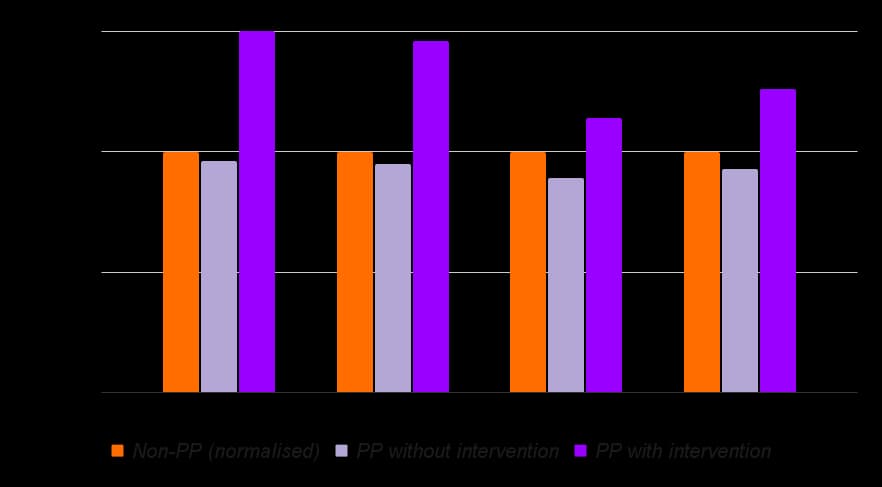
The uplift was larger in years 7 and 8 than in years 9 and 10, which Tassomai’s founder Murray Morrison puts down to the size of the courses:
“We observed that across the board, PP students were behind their peers, and this additional Boost intervention was closing that gap. The effect appears greater in KS3 than KS4, but this is largely down to the relative size and scope of the courses; in reality the effect appears quite consistent.”
The pattern was consistent across all four year groups: in each one, Pupil Premium students with Boost made more course progress per question than Pupil Premium students without it.
What this means for your Pupil Premium strategy
Schools have to review and publish their Pupil Premium strategy statement every year before 31 December, and the EEF guide asks leaders to evaluate whether each approach is working [2]. Three points from the trial are worth taking into that review:
Target the time students already spend. If disadvantaged students do less independent study, an intervention that raises the value of each session can help them get more from the time they have.
Keep support inside normal work. Built into routine homework, the intervention reaches students without singling them out.
Ask for the comparison. When a provider quotes an uplift, ask what it was measured against, how many students were involved and what the outcome measure was. For this trial, those answers are in the table above.
How schools get Pupil Premium Boost
Pupil Premium Boost is now part of our Equity and Inclusion suite, alongside SEND Boost and EAL Boost (Multi-Lingual Mai). Pupil Premium students get weekly Leapfrog Sessions and unlimited access to Mai at no extra cost to their families.
Our team works with your school’s main Tassomai contact to identify eligible students, and nothing else is needed once it’s set up. Schools that add it agree to share outcomes data, so we can keep measuring its impact. There’s more detail on the Pupil Premium Boost page.

Frequently asked questions
Yes. Families who get Tassomai through school can add weekly Leapfrog Sessions and unlimited access to Mai for a low monthly subscription. Pupil Premium Boost makes sure the families least able to pay for these upgrades aren’t left out.
No. Once your school’s eligible students are set up, Leapfrog Sessions and Mai access switch on for them automatically. We do suggest sharing the Pupil Premium Boost page with colleagues so they know it’s running.
Already using Tassomai? Talk to your Customer Success Manager or email hello@tassomai.com to add Pupil Premium Boost. New to Tassomai? Book a demo, and if it looks right for your school we’ll set you up with a free three-week trial.
References
Department for Education. (2026). Key stage 4 performance: Academic year 2025/26. Explore education statistics. https://explore-education-statistics.service.gov.uk/find-statistics/key-stage-4-performance/2025-26
Education Endowment Foundation. (2026). The EEF guide to the Pupil Premium. https://educationendowmentfoundation.org.uk/using-pupil-premium
Tagged: Pupil Premium, Pupil Premium Boost, Boost, Attainment, Attainment gap, Disadvantage gap, Teacher hub page, Impact