
GCSE Chemistry Tricky Topics: Redox and Displacement Reactions
Georgia Grigor
Content Officer
Published
3 min read

Displacement reactions and redox processes form a vital foundation across both Foundation and Higher tier GCSE chemistry specifications. While predicting which element gets displaced using the reactivity series is relatively simple, exam questions that demand an explanation in terms of electron transfer frequently cost students marks. In AQA’s June 2023 Higher tier paper, fewer than one in seven students could use a set of displacement reactions to work out which metal most readily forms positive ions [1].
This revision guide combines reactivity principles with redox definitions so you can tackle these exam questions with confidence. Prefer to watch? Tassomai’s founder Murray Morrison explains it in 96 seconds.
1. What are displacement reactions?
A displacement reaction takes place when a more reactive metal takes the place of a less reactive metal in a compound. Displacement reactions are a type of redox reaction: the more reactive metal loses electrons and the metal ion in the compound gains them.
The governing rule is straightforward: if the uncombined, free metal is higher in the reactivity series than the metal in the compound, a reaction occurs. If it is lower, no reaction happens.
The reactivity series orders metals from most to least reactive [2][3]:
Potassium > Sodium > Calcium > Magnesium > Aluminium > Zinc > Iron > Copper > Silver > Gold
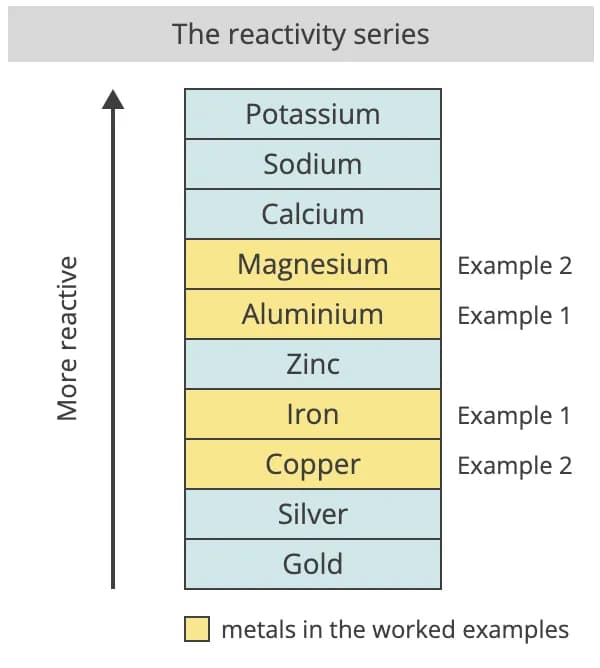
A more reactive metal has a higher affinity for oxygen and non-metal anions. Because of this greater chemical drive, it bonds with the non-metal and pushes the less reactive metal out as a pure element.
2. Defining redox: the OIL RIG rule
Historically, oxidation meant adding oxygen (such as iron reacting with oxygen and water to form rust), while reduction meant removing oxygen. You still need these oxygen definitions at both tiers. At Higher tier, you must also define redox reactions through electron transfer [2][3]. The mnemonic OIL RIG can be used to help you remember the difference between oxidation and reduction:
OIL RIG
Oxidation Is Loss (of electrons)
Reduction Is Gain (of electrons)
When a neutral metal atom loses electrons, it forms a positive metal cation; it has been oxidised. When a positive metal ion gains electrons to return to a neutral element, it has been reduced.
3. Worked reaction examples
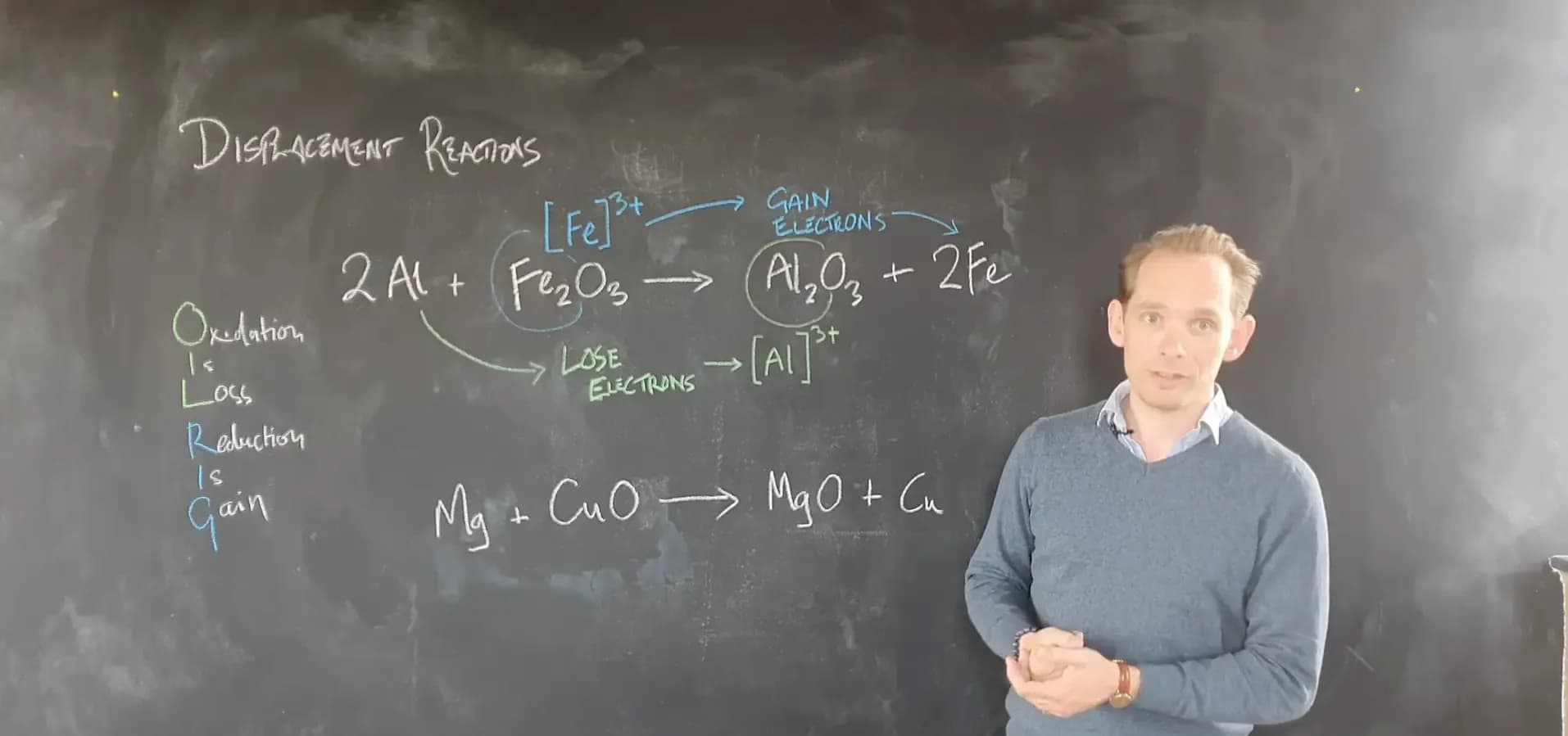
Example 1: aluminium and iron oxide (thermite reaction)
Reactivity check: aluminium is higher in the reactivity series than iron, so displacement occurs.
Oxidation: neutral aluminium atoms (Al) lose electrons to form Al³⁺ ions in aluminium oxide. Aluminium is oxidised.
Reduction: Fe³⁺ ions in iron(III) oxide gain electrons to form neutral iron atoms (Fe). Iron oxide is reduced.
Example 2: magnesium and copper oxide
Reactivity check: magnesium is above copper, so it displaces copper from copper(II) oxide.
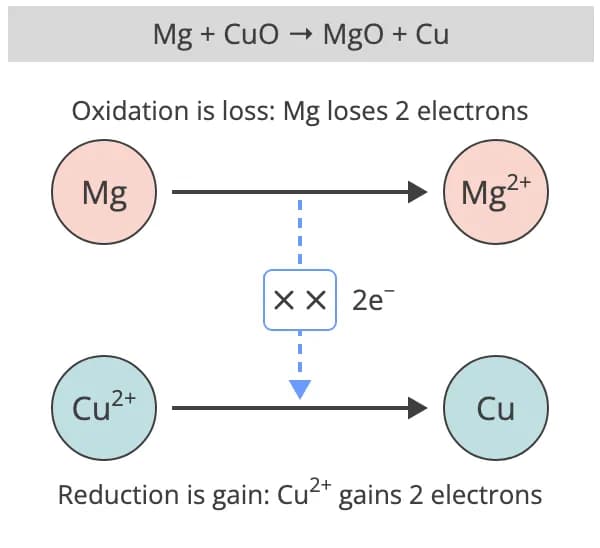
Oxidation: neutral magnesium atoms lose two electrons to form Mg²⁺ ions. Magnesium is oxidised.
Reduction: Cu²⁺ ions gain two electrons to form elemental copper. Copper oxide is reduced.
4. Identifying oxidising and reducing agents
An agent facilitates a process for another substance:
Oxidising agent: gains electrons and is itself reduced (e.g. CuO, Fe₂O₃).
Reducing agent: donates electrons and is itself oxidised (e.g. Mg, Al).
Redox summary table
| Reactant | Electron movement | Redox state | Agent role |
|---|---|---|---|
| Magnesium (Mg) | Loses electrons | Oxidised | Reducing agent |
| Copper oxide (CuO) | Gains electrons | Reduced | Oxidising agent |
| Aluminium (Al) | Loses electrons | Oxidised | Reducing agent |
| Iron oxide (Fe₂O₃) | Gains electrons | Reduced | Oxidising agent |
Frequently asked questions
Iron sits higher in the reactivity series than copper. Copper cannot displace iron ions from solution, resulting in no chemical change.
Rusting is specifically the oxidation of iron combining with oxygen in the presence of water to form hydrated iron(III) oxide. Displacement requires one metal displacing another from a compound.
Locate the neutral free metal on the reactant side that is losing electrons. Because it donates electrons to reduce the metal ion, it acts as the reducing agent.
Exam revision tip
To score full marks on 3-mark displacement questions:
State which free metal is higher in the reactivity series.
Quote OIL RIG to state which atoms lose electrons (oxidised).
Identify which positive ions gain electrons (reduced).
Tassomai’s GCSE science course quizzes you on topics like this little and often, so the rules stick by exam day.
References
AQA. (2023). Report on the examination: GCSE chemistry 8462/1H, Paper 1 Higher tier, June 2023 (Version 1). https://cdn.sanity.io/files/p28bar15/green/0bd44448448764aa80f567e895859f5882e9a4b1.pdf
AQA. (2019). GCSE chemistry (8462) specification (Version 1.1). https://filestore.aqa.org.uk/resources/chemistry/specifications/AQA-8462-SP-2016.PDF
Pearson Education. (2024). Pearson Edexcel Level 1/Level 2 GCSE (9-1) in Chemistry (1CH0) specification (Issue 4). https://qualifications.pearson.com/content/dam/pdf/GCSE/Science/2016/Specification/gcse-chemistry-spec.pdf
Tagged: GCSE, GCSE Chemistry, GCSE science, Revision, chemistry, Displacement Reactions