
Building resilience in your children - 5 steps for parents
Tassomai
5 min read

Sam Clark, teacher, writer and founder of the Resilience for Kids website gives us his best advice for parents on building resilience and supporting their children’s wellbeing.
The pandemic has shone a light on mental health like never before, but amongst Olympic athlete withdrawals and adult burnout, we seem to be neglecting our children. How do we effectively support their mental health?
I have spent a decade in a range of schools trying to find answers, and the one thing that has proved almost universally effective is when a child is given the tools to be resilient. The problem is that resilience is a complex beast – in most cases, it can’t be built with just a definition and a Thomas Edison quote. Resilience needs to be unpicked, discussed, modelled and reviewed.
Below are five practical steps that can help you build the resilience of your children.
STEP 1: OPENNESS
Developing an environment where children feel confident to talk openly is the absolute foundation for building resilience. To encourage this, we need to make it clear that life is no fairy tale, and that everybody faces challenges every day. The recognition of this belief will make children much more likely to speak out.
Having adults model openness is important too. It might seem strange to share your fears and hopes with your children but this will further encourage that open dialogue. Providing the knowledge (the why) can be a gamechanger for some. The moment children realise that expressing themselves is a healthy discipline and helps to ease their fears, they are often sparked into sharing their thoughts.
STEP 2: EMOTIONS
The first thing is to build emotional vocabulary. There is often very little knowledge of emotions outside the big four: happy, sad, jealous, angry. Regularly referencing a range of emotions will give children the scaffold they need to be precise when opening up about the challenges that they face.
The emotion I am asked most about is anger. We have addressed this emotion with the following image.
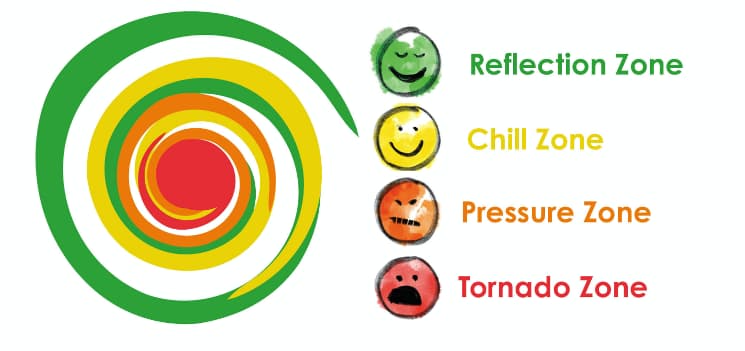
The Tornado Zone engages children for numerous reasons – they like the colours and faces but also appreciate the concept as it helps them recognise the different stages of anger. Once embedded, this image can be used to identify the triggers that make children fall into the Tornado Zone. Examples could be losing, being left out, or in my case twenty years ago, having your younger sister change the channel when you are watching football! Trigger recognition is important because it gives children extra time to process those triggers when they happen.
Next are the practical steps to help children when they fall into the Tornado Zone.
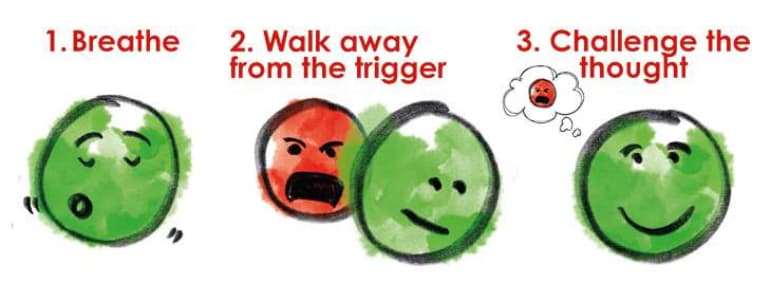
The more these steps are referred to, the greater chance they will be applied. The language also provides a reference point to support follow-up conversations about any behaviour infractions.
STEP 3: FAILURE
Informing children that failure can be the first step to success is a real lightbulb moment. Failure can often be a child’s trigger – losing a football match, getting a bad score in a maths test, not being picked for the school play – so explaining that failure will create an ‘emotional explosion’ is an important signpost for children. We have depicted this moment as falling into the Pit of Failure (there are many similarities here with the Tornado Zone).
It is then reviewing what to do to self-regulate: take a deep breath, walk away from the trigger and challenge the thought before understanding how to climb out of the Pit of Failure. The steps are shown in the diagram below:
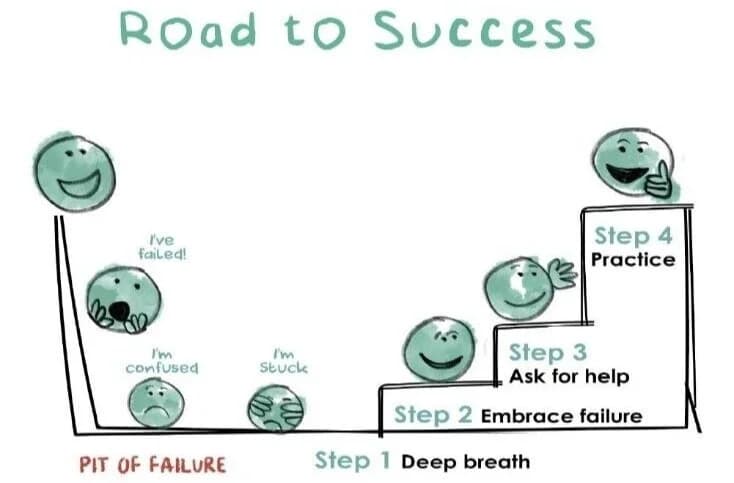
Throughout my teaching career, I have referred to this image thousands of times. It is worth having it visible so that when failure occurs, children have the knowledge available to tackle failure in a resilient manner.
STEP 4 – OTHER PEOPLE
When you are sharing a room with thirty other children for nearly six hours a day, you need to develop skills to manage those around you. The key point here is to communicate to children that peers/friends are not always going to bring joy and positivity. Recognising this takes away the surprise when a sibling or friend says or does something negative.
Managing other people can be broken down into two areas. The first is to avoid being dragged down into the Tornado Zone by others. “Respond rather than react” is a phrase that can be used to encourage this.
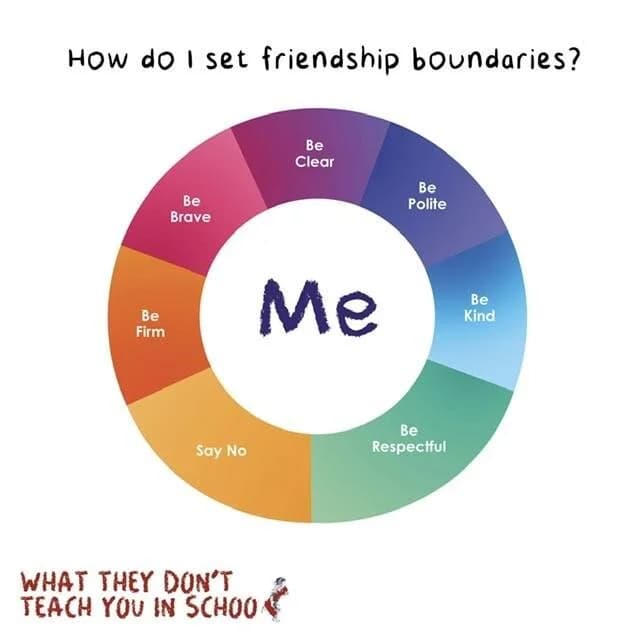
The second – and I wish I would have been taught this when I was at school – is the ability to set healthy boundaries. Explaining to children that it is important to be kind but also to think about their own needs can be a huge moment. Supporting children to say no is imperative here. The diagram below outlines how to do this:
STEP 5 – TAKING RESPONSIBILITY
Seeing a child take responsibility for their actions might be one of the most wonderful things. Well, we have to work hard on this because this might be the most challenging area of resilience. First, we have to manage the emotions that explode into life when a mistake is made. Shame, guilt, embarrassment – these can trigger the dreaded Escape Thoughts.
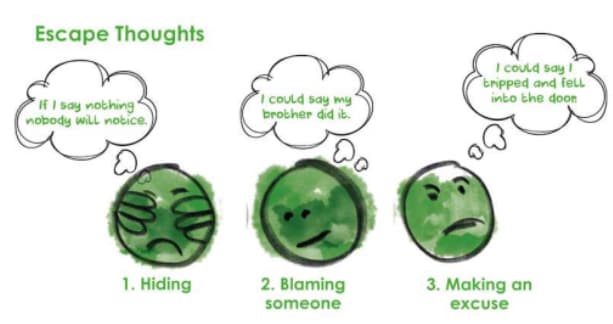
It is at this point that we remind our children how to self-regulate. However, with punishment looming, taking a deep breath can be a hard sell for most children so here comes the why again. Why should we take responsibility for our actions?
Answers:
If we don’t admit our mistakes then it is impossible to learn from them.
Taking responsibility helps to build trust in relationships.
The more you hide/lie the more anxious you will feel.
These reasons are often enough to encourage children to come clean and own their actions but this is unquestionably the most unpredictable area of resilience. Each reaction is dependent on the mistake, the people involved and the severity of the consequence.
I hope the steps to resilience have been useful. All of these (and more!) can be found in What They Don’t Teach You in School – a workbook designed to help parents build the resilience of children.
- Sam Clark (@open_youngminds on Twitter)
Read more articles from our GCSE Survival Guide series
View all GCSE Survival Guide articles
2 January 2025 · Article, Tips for parents, Tips for students, Tips for users
Exams this year? Here’s how to make the most of the next few months (and how Tassomai can help!)
2025 is just beginning but exam season will come around quickly! Here’s what parents can expect over the next 6 months, and how they can help students prepare for exams.
1 December 2022 · Tips for students
Tassomai’s New GCSE Survival Guide for Students!
As students look towards the new year, with the return of strict grade boundaries and exams looming on the horizon, Tassomai has published a free guide for students to help them navigate the challenging GCSE years.
26 September 2022 · Tips for parents, Tips for teachers, News
New GCSE Survival Guide - Practical Advice for Parents of Y9-11s
As a new cohort of students embark upon their GCSE journey and others begin to think about their mocks, Tassomai has published an updated (free) guide for parents to help them navigate what can be a challenging time for families.
3 February 2022 · Tips for parents
5 ways to support your child’s mental health throughout their GCSEs
As we look towards end of year assessments, Tassomai asks mental health and education experts what their top pieces of advice are for parents supporting their children’s wellbeing.

2 December 2021 · Tips for parents
A Step-By-Step Guide to Revising for GCSEs
Matt Green, The Rapping Science Teacher on tiktok and the owner of JGM Science Tutors, speaks to Tassomai about his foolproof method for getting revision started (unfortunately, it’s not rapping).

23 November 2021 · Tips for parents, Tips for teachers
Top tips for parents from a senior leader
Karen Collins, Lead Science Associate for PiXL, speaks to Tassomai about the structure of the science GCSEs and how parents can best prepare themselves and their children for science assessments.

11 November 2021 · Tips for parents
Spotting the signs of exam stress in GCSE students
Are they burying their head in the sand like the ostrich or are they more like the laid-back lion? Tassomai founder Murray Morrison presents a few classic archetypes of exam-stressed children !

4 November 2021 · Tips for parents
A Parents’ Guide to GCSE Revision
Abi Ludlow, English teacher and KS3 Lead at Richard Lander School tells parents exactly what they need to know about their child’s revision schedule , and where they fit in!
Tagged: GCSE Survival Guide, Mental Health, Resilience, Sam Clark