
The menstrual cycle: GCSE biology hormones explained
Tassomai
Published
Updated
4 min read
The menstrual cycle is a cycle of about 28 days in which the lining of the uterus is prepared for pregnancy. It is controlled by four hormones: FSH and LH from the pituitary gland, and oestrogen and progesterone from the ovaries [1]. If no fertilised egg implants, the lining breaks down and is lost as a period.
| Hormone | Made in | What it does |
|---|---|---|
| FSH (follicle stimulating hormone) | Pituitary gland | Causes an egg to mature in an ovary and stimulates the ovaries to release oestrogen |
| Oestrogen | Ovaries | Repairs, thickens and maintains the uterus lining, stops FSH being produced and stimulates the release of LH |
| LH (luteinising hormone) | Pituitary gland | Triggers ovulation, the release of a mature egg |
| Progesterone | Ovaries | Maintains the uterus lining during the middle part of the cycle and during pregnancy |
How to remember the four hormones
FSH and LH come from the pituitary gland; oestrogen and progesterone come from the ovaries. In the order they peak: FSH matures the egg, oestrogen builds the lining, LH releases the egg and progesterone keeps the lining in place.
We’ve looked through the Tassomai data, and found some of the GCSE science topics that our students find the hardest! We’ll post a brief explainer on each of these topics over the next few weeks in the run up to exam season. Give this series a read if you, your child or your students are struggling with any part of Tassomai - even if these particular topics aren’t problematic, we’ll also touch on some common errors students make when answering questions on Tassomai!
The hormones in the menstrual cycle
There are four key hormones involved in the menstrual cycle:
Oestrogen
Progesterone
Follicle Stimulating Hormone (FSH)
Luteinising Hormone (LH)
This article is going to go over what these hormones do, how they interact, and when they are released. The menstrual cycle lasts for about 28 days.
Here’s an example Tassomai Question:
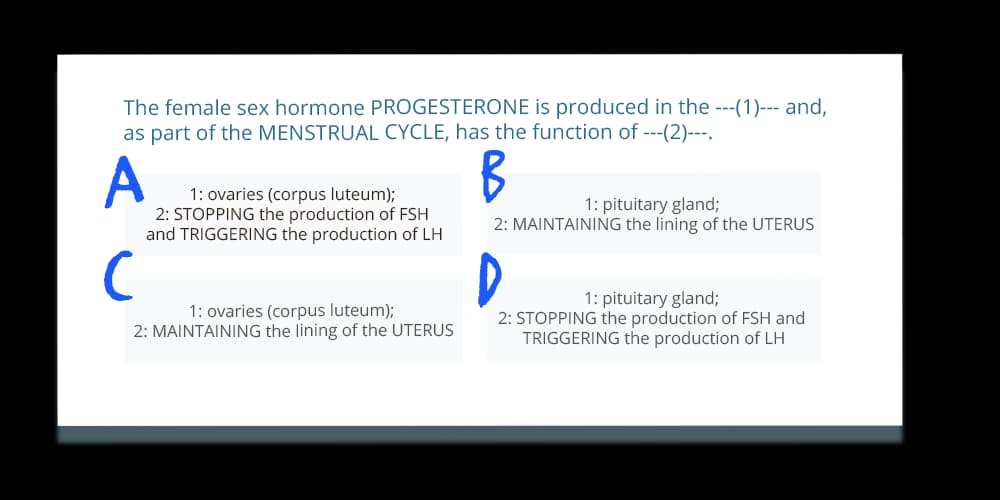

This question asks about where progesterone is produced and what it does - but it’s important to know where all the hormones are produced and what they do.
All four hormones are produced constantly, but not the same amount all the time - at certain points in the cycle some will increase in level, while others will drop.
Oestrogen
Oestrogen is perhaps best known for its role during puberty - it causes the development of secondary sexual characteristics - but it also has a key role in the menstrual cycle.
Effect: Oestrogen thickens, repairs and maintains the uterus lining. It also stops FSH being produced, so that only one egg matures, and stimulates the pituitary gland to release LH [1].
Where is it produced: In the ovaries.
Progesterone
Effect: Progesterone maintains the uterus lining so that if the egg is fertilised it can embed in the uterus lining.
Where is it produced: In the ovaries.
Follicle Stimulating Hormone (FSH)
Effect: FSH causes the egg to mature in the ovary. It also stimulates the ovaries to release oestrogen.
Where it is produced: In the pituitary gland.
Luteinising Hormone (LH)
Effect: LH stimulates the release of the egg.
Where is it produced: In the pituitary gland.
The Cycle (simplified)
The menstrual cycle can be broken down into 4 stages:
Stage A: Days 1-5 - Menstruation
Stage B: Days 5-12 - Building uterus lining
Stage C: Days 12-15 - Ovulation
Stage D: Days 15-28 - Maintenance of uterus lining
Menstruation: For the first 5 days all four hormones are at a pretty constant level as the uterus lining is shed - this is known as the period or menstruation.
Preparing for ovulation: During this time, FSH levels increase causing an egg to mature in the ovary. Meanwhile, oestrogen begins to rise on approximately day 7, reaching a peak on day 12. This builds the uterus lining, meaning that if the egg is fertilised it can be embedded in the uterus
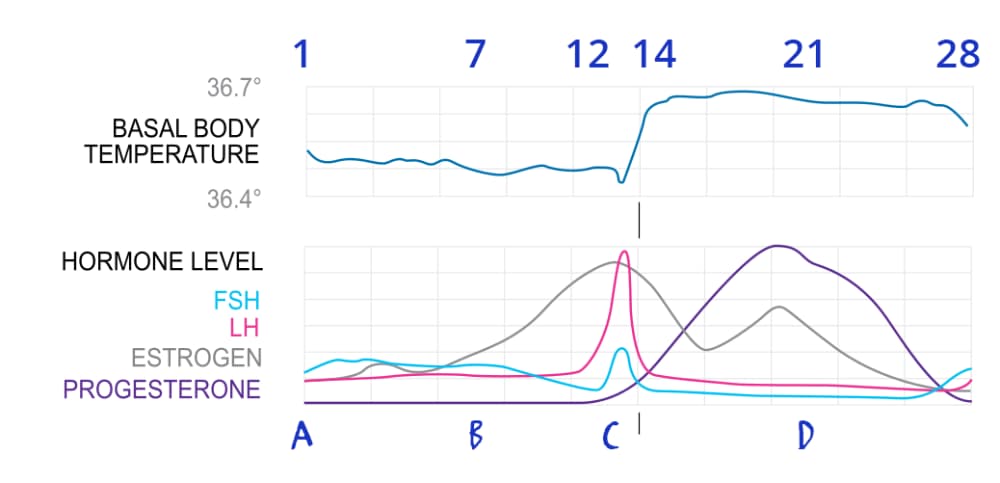
Attribution: Isometrik [CC BY-SA 3.0 (https://creativecommons.org/licenses/by-sa/3.0)] - changes have been made to remove information not required for GCSE students
Ovulation: As oestrogen begins to fall on day 12, the next stage of the cycle starts. LH and FSH rise sharply and peak around day 14, before dropping again on day 15. The LH surge is triggered by the high level of oestrogen, and it is this rise in LH that causes the egg to be released [1].
Maintenance of uterus lining: After the egg is released, LH and FSH fall back to their original levels - they don’t have anything else to do in this cycle. Oestrogen has also fallen back to its original level, but it then begins to gradually rise again - and this is also when progesterone levels start to increase. This is because they both maintain the uterus lining, and they therefore both peak on day 21 (although this is a smaller peak for oestrogen than on day 12). They then both gradually fall back down to their original levels, which they reach on day 28. This is when the cycle restarts, and the uterus lining is shed.
This question
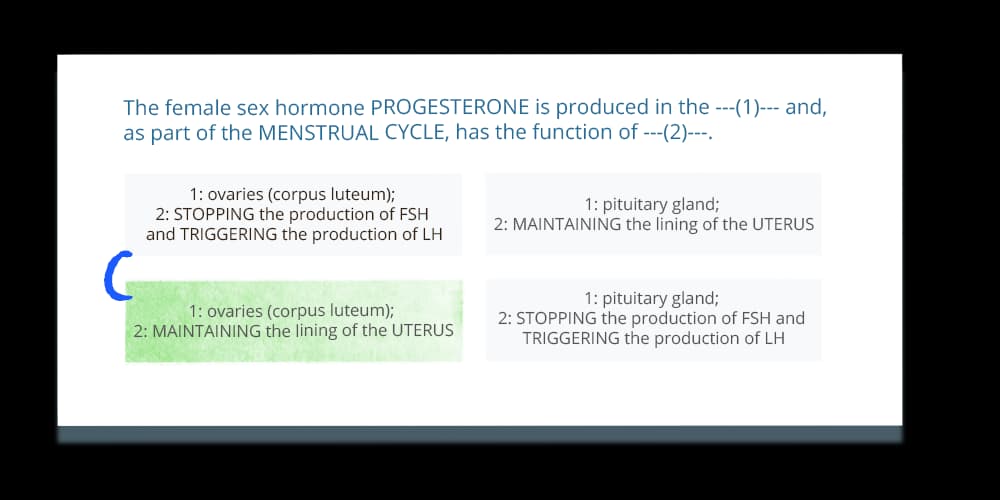
We now know that it is LH and FSH which are produced in the pituitary gland, and oestrogen and progesterone which are produced in the ovaries - therefore the answer is one of C or D.
We also know that both oestrogen and progesterone maintain the uterus lining - but it is oestrogen, not progesterone, which stops FSH production and triggers the release of LH. Therefore the answer is C - progesterone is produced in the ovaries, and maintains the uterus lining.
Discover the secret to good grades
Schools can trial Tassomai for 3 weeks and private subscribing families get a 7-day free trial. Click a link below to learn more about Tassomai:
Frequently asked questions
Menstruation (days 1 to 5), when the uterus lining is lost; the lining builds up again (days 5 to 12); ovulation, when an egg is released (around day 14); and the lining is maintained (days 15 to 28), ready for a fertilised egg.
Oestrogen is made in the ovaries. It repairs, thickens and maintains the uterus lining, stops FSH being produced so that only one egg matures, and stimulates the pituitary gland to release LH.
LH (luteinising hormone), released by the pituitary gland. A surge in LH around day 14 causes a mature egg to be released from the ovary.
References
BBC Bitesize. (n.d.). Reproductive hormones in the menstrual cycle (AQA GCSE combined science). BBC. https://www.bbc.co.uk/bitesize/guides/zt2yxfr/revision/1
BBC Bitesize. (n.d.). Hormones in control of the menstrual cycle (AQA GCSE biology). BBC. https://www.bbc.co.uk/bitesize/guides/zs9hb82/revision/2
Tagged: Tricky Topics, Revision, Understanding