
Making the Grade with Tassomai
Tassomai
4 min read
How we got our best Triple Science results in 10 years!
By Carole Dean, Deputy Headteacher at The Stonehenge School.
Three years ago we discovered Tassomai, and decided to use it with one of our key Year 11 classes. This worked with reasonable success, but students within the class thought that they were being singled out and made to do extra as some sort of punishment, and students who were in the other classes demanded to know why it hadn’t been provided for all of them.
Whilst Tassomai certainly had an impact on the students who used it, we quickly decided that it made much more sense for all students to be given access. As we’ve seen the benefits, we have added it to more year groups, so that we included 10 and 11, and this year we will be including our Year 9s as well since they start full GCSE content at Christmas of that year.
The Impact on Grades
Results in science have been an area for improvement for many years, with results often within the lowest 20% in the country (or described as Sig Minus), and below attainment in English and maths. We hoped that using Tassomai would help us to improve results to take us to the national average. However, results this year have gone beyond this, and we have beaten FFT20 targets. All of the students entered for Triple Science passed, with the best results for Triple Science that we have seen for at least ten years.
Improvements in Combined Science were spectacular with a 14% increase in the number of passes, and a Progress 8 score above zero (which had previously been -0.64).
Reducing the gender gap
Tassomai has helped us to drastically reduce our gender gaps in triple and double science. Like many schools, girls outperform boys in many of their subjects; we were no different. Now we’ve got the boys outperforming girls in science and I’d put that mostly down to the enthusiasm that they showed for using Tassomai on a regular basis.
Boys in particular have enjoyed the idea of hitting the daily goals, and they respond well to their revision being broken down and planned for them. They like the convenience of being able to complete it at any time of the day, in easy chunks, and using their own mobile devices.
All the children like the competitive element, but I think this works particularly well with some of the boys – we use league tables and prizes for attainment and progression, especially during the holidays. We have some really keen students, one of our students completed the entire course (covering all specification points) by the start of Year 11!
A scientific approach to teaching
A key benefit for our science teachers is that they like the way Tassomai is constantly reminding students of material they’ve learned over the course of the 2 year GCSE period. Before our students had access to Tassomai, they found revising science over-whelming, but through introducing them to the program, they are now revising throughout the entire course. Teachers can monitor how much they are doing, how often, and how much they are answering accurately. It is easy to target students who are not engaging with it, but also to gain an understanding of which areas they are finding difficult and help them to address this.
The way Tassomai works means that students are revisiting knowledge after periods of time, so it applies the concepts of interleaving and spacing. Teachers can control the content that is questioned, so it can be used to consolidate, but also question on units that haven’t been delivered in the classroom, meaning that students are able to flip their learning, and explore content in advance.
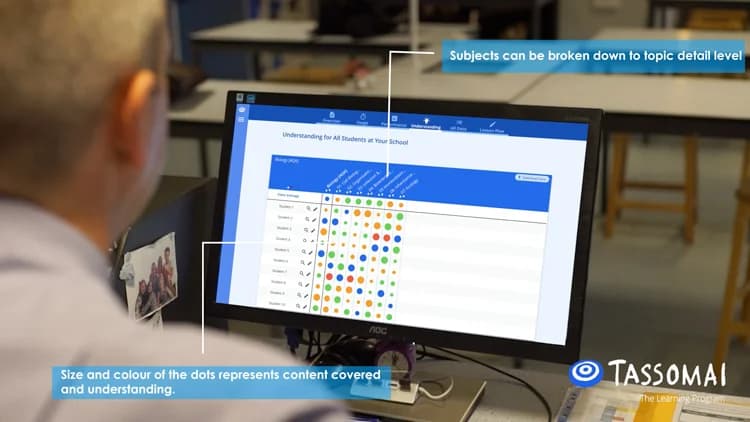
Teachers use Tassomai data to plan and target intervention, and to inform their teaching. Before Tassomai, our teachers used tests and exams to create Personalised Learning Charts for each student, logging their ability and confidence for each part of the science curriculum; a very long time-consuming process. Now Tassomai does this work for them, impacting positively on their workload. Teachers have diagnostic information relating to each student and each area of the curriculum that is kept live, not relying on tests or marking, meaning they can focus on actually teaching those topics and targeting weak areas.
Changing attitudes to science
Tassomai has made a massive difference to attitudes towards science. It’s increased competition and changed the attitude to revision. It’s boosted confidence. Constantly revisiting and reviewing knowledge means that students are able to tackle the new reformed GCSE content in a way that it is pitched at their own ability and personalised to them.
What would I say to schools thinking of investing in Tassomai?
Do it! Go for whole cohorts of students as it benefits all abilities. Students will appreciate the support it gives them with challenging amounts of content (and having their revision planned for them) and teaching staff will appreciate the time they save and the information that they gain.
All case studies
View all case studies
9 January 2026 · Case study, Tips for teachers
How whole-school culture and multi-subject strategy drove outstanding Tassomai engagement
How Sir Thomas Wharton Academy embedded Tassomai across subjects to build strong routines and exceptional engagement.

9 January 2026 · Case study, Tips for teachers
How creative rewards — from Tassimals to queue-jump passes — transformed student motivation at STWA.

28 March 2025 · Case study, Tips for teachers
“Great bang for your buck” - A headteacher’s verdict on Tassomai and its impact
Dr Paul Bell tells us how Horsforth School has embraced Tassomai to improve student engagement, reduce teacher workload, and drive better results.

5 November 2024 · Case study, Tips for teachers
How Class Tasks make homework less work
Holly Bradshaw , Curriculum Leader for Science at Marple Hall School , spoke to us about how Class Tasks are helping with homework setting and boosting students’ confidence.

26 June 2024 · Case study, Tips for teachers
The Tassomai impact on Humanities
Clare Quarton, Teaching Team Leader for Humanities at Treviglas Academy, Newquay tells us about the impact Tassomai has had and how they’ve made homework fun, engaging and a little bit competitive for students.

26 June 2024 · Case study, Tips for teachers
Setting students on a path to top grades in GCSE geography with Tassomai
Geography is a very content-heavy subject, so it can be tough for teachers to cover the syllabus more than once. Using Tassomai to revise and recap has really helped helped her students, says Charlotte Pollard, a Geography ECT at Treviglas Academy in Newquay .

24 April 2024 · Case study, Tips for teachers
Using Tassomai’s maths content to build good learning habits at key stage 3
Kyle Parsad talks about his experience of using Tassomai’s maths content to build good learning habits among his KS3 students, and about its positive impact on teacher workload.

27 March 2024 · Case study, Tips for teachers
Using Tassomai to help teach GCSE history
A history teacher at Chase High School in Southend-on-Sea shares his experience of using the edtech retrieval practice program "Tassomai" to help embed knowledge with his GCSE history students.
Tagged: Stonehenge School, GCSE results, Gender gap, Carole Dean, Impact, Science subject page